Crop without cutting the ears
After auto-crop, inspect ear tips, tail and paws. A little empty space is better than losing a distinctive silhouette.
Pet photos are difficult because fur contains many gradients, backgrounds reflect into coat color, and small changes to eyes or nose affect likeness. A direct pixel conversion often produces dirty speckles. A better workflow preserves ears, face shape, markings and pose first, then reduces fur to a small set of useful color regions.
This example preserves the relative size of both cats, their ears, eyes, noses and main coat colors while removing the indoor background and thousands of tiny fur variations. The final chart still distinguishes each cat, but the color regions and edges are simple enough to place bead by bead.


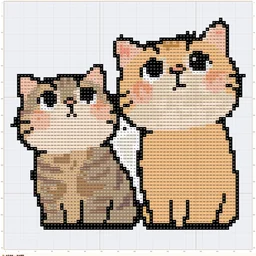
Choose pet headshot, one full-body pet or a two-pet photo, then select simple or likeness-first output. The tool recommends grid width, colors, estimated beads and background treatment.
Estimates are for planning. Use the generated color count as the final supply list.
After auto-crop, inspect ear tips, tail and paws. A little empty space is better than losing a distinctive silhouette.
Use chibi or pixel cleanup to merge hundreds of fur shades into main coat, shadow and outline colors while keeping markings in place.
Fix eye spacing, nose position, inner-ear color and forehead or chest markings before editing individual fur pixels.
Use about 40–56 cells for one headshot, 48–64 for one full-body pet and 64–80 for two pets or complex markings.
No, but backgrounds add unrelated colors and beads. Remove it for a standalone ornament, magnet or framed subject.
Preserve at least one dark gray or brown-black internal tone and keep lighter separation around eyes, nose and ears instead of mapping everything to pure black.
Use light gray and warm white for body depth, keep the background distinct, and retain a darker outer contour. Do not treat every white region as transparent.
Yes. The conversion should follow the source pose rather than forcing a front view. Side-profile ears and head tilt are often important identity cues.